MEDUSA
BECOME MONSTROUS!
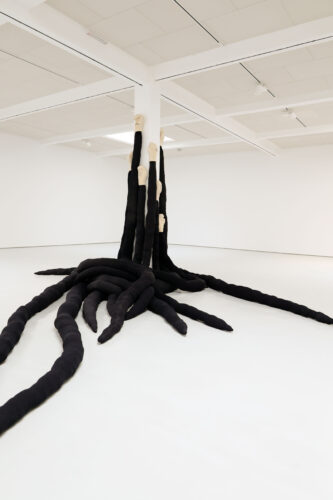
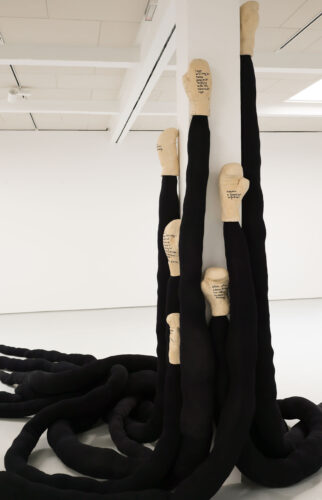
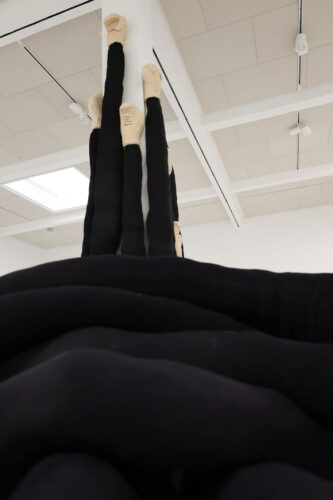
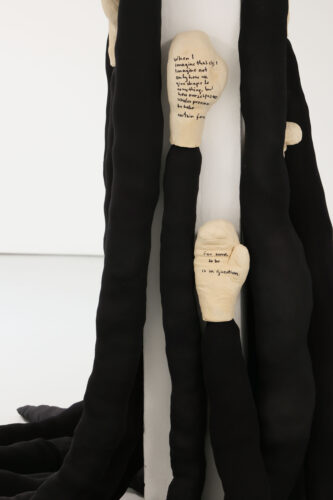
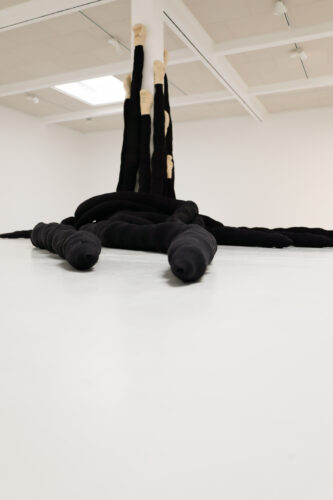
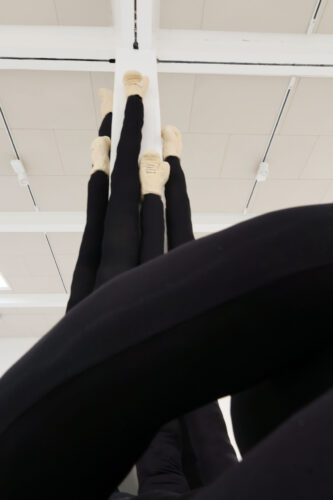

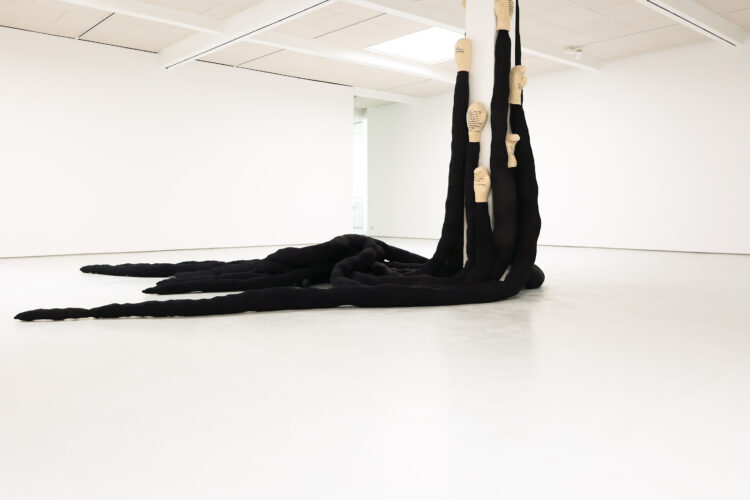
Images by Judith Klemenc
2024. Textil, Ton. 400 x 220 cm
2024. textil, clay. 400 x 220 cm
Ton symbolisiert das Material, aus dem der Mensch geformt wurde und vor allem wie er geformt wurde/wird. Darin liegt auch die gesellschafts- und machtkritische Bedeutung: So wie der Mensch geformt wurde kann er sich auch selbstbestimmt um-formen: ein symbolischer Apell des Empowerments.
Eine der jüngsten Arbeiten von Judith Klemenc, MEDUSA. BECOME MONSTROUS! (2024) setzt sie ihre Experimente mit großformatigen monochromen Textilskulpturen fort, die an schlangenartige Formen erinnern und im Falle dieser Arbeit direkt an feministische Wiederaneignungen des antiken griechischen Mythos der Medusa anknüpfen. Medusa, ursprünglich als bezaubernde Schönheit beschrieben, wurde aufgrund der Verführung/Vergewaltigung seitens Poseidons von Pallas Athene in ein Monster mit Schlangenhaaren, glühenden Augen und herausragender Zunge verwandelt, dessen Anblick jeden in Stein verwandelt. In westlichen feministischen Interpretationen dieses Mythos erscheint Medusa als eine mächtige Figur, deren Stärke patriarchale Panik auslöst, und sie ist zu einem Symbol feministischer Bewegungen und feministischer Popkultur geworden. Klemenc konzeptualisiert Medusa als Widerstand gegen eine patriarchale Dämonisierung von Frauen, auch unter Frauen, um die Fort- und Einschreibung von patriarchaler Gewalt zu unterbrechen. In ihrer Installation MEDUSA. BECOME MONSTROUS! wird Medusa nicht in ihrer Dar- und Vorstellung von Monster bedeutend, sondern in ihrer Monstrosität, um für eine Solidarisierung gegen patriarchale Gewalt aufzurufen. Ihre Schlangenhaare aus Textil entfalten sich im Raum, umwachsen die tragende Säule und ballen sich in zerbrechlichen Boxhandschuhen aus Ton zu Fäusten, die das Bild der feministischen Solidarität und des Kampfes für Rechte und Würde evozieren. Auf den widersprüchlichen Boxhandschuhen aus Ton sind Zitate der Theoretikerin Sara Ahmed eingraviert, die für ihre Arbeit zu Feminismus, Queer und Critical Race Theory bekannt ist: “When I imagine that clay, I imagine not only how we give shape to something, but how we ourselves are under pressure to take a certain form”; “When you have to fight for existence, fighting can become an existence”; “When critique causes damage, I am willing to cause damage”; “White feminism = blanking”; “Silence about violence is violence”; “Become a feminist infection!”; “Become monstrous”
(Sara Ahmed, The feminist killjoy handbook. Milton Keynes, Dublin: Allen Lane, 2023)
Clay symbolizes the material from which humans were formed, and especially how they were/will be formed. Therein lies also the societal and critical power: Just as humans were formed, they can also autonomously transform themselves: a symbolic call for empowerment. One of the recent works by Judith Klemenc, MEDUSA. BECOME MONSTROUS! (2024), continues her experiments with large-scale monochromatic textile sculptures, reminiscent of serpent-like forms, and in the case of this work, directly tied to feminist reappropriations of the ancient Greek myth of Medusa. Originally described as an enchanting beauty, Medusa was transformed into a monster with snake hair, glowing eyes, and a protruding tongue by Pallas Athena due to seduction/rape by Poseidon, turning anyone who looked at her into stone. In Western feminist interpretations of this myth, Medusa appears as a powerful figure whose strength triggers patriarchal panic, and she has become a symbol of feminist movements and feminist pop culture. Klemenc conceptualizes Medusa as resistance against patriarchal demonization of women, even among women, to interrupt the perpetuation and inscription of patriarchal violence. In her installation MEDUSA. BECOME MONSTROUS! Medusa becomes significant not in her portrayal and conception of monster, but in her monstrosity, to call for solidarity against patriarchal violence. Her textile snake hair unfolds in space, enveloping the supporting pillar and clenches her history-writing snake hair in fragile boxing gloves of clay, evoking the image of feminist solidarity and the struggle for rights and dignity. The contradictory boxing gloves are engraved with quotes by Sara Ahmed who is known for her work on feminism, queer and critical race theory, including: “When I imagine that clay, I imagine not only how we give shape to something, but how we ourselves are under pressure to take a certain form”; “When you have to fight for existence, fighting can become an existence”; “When critique causes damage, I am willing to cause damage”; “White feminism = blanking”; “Silence about violence is violence”; “Become a feminist infection!”; “Become monstrous”
(Sara Ahmed, The feminist killjoy handbook. Milton Keynes, Dublin: Allen Lane, 2023)
